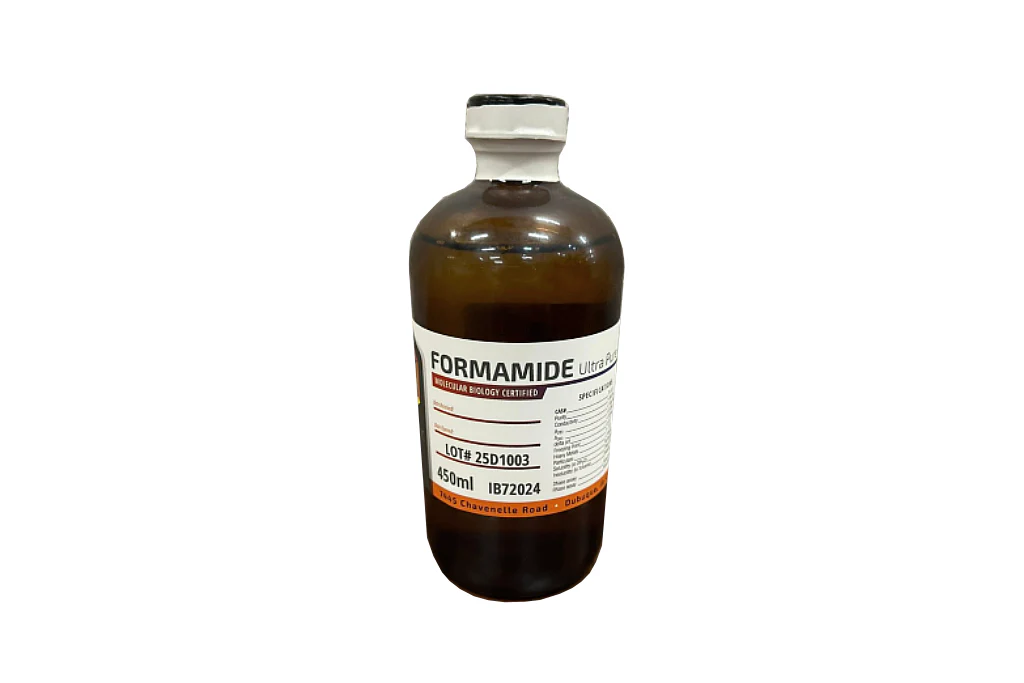
Formamide, Spectral Grade
Spectral Grade Formamide – High-Purity Formamide for Molecular Biology Applications
Formamide is an essential reagent in molecular biology and biochemistry, widely known for its ability to denature nucleic acids, lower the melting temperature of DNA, and enhance hybridization efficiency. Spectral Grade Formamide is a high-purity solution designed for critical laboratory applications, including DNA and RNA hybridization, gel electrophoresis, immunohistochemistry, and fluorescence in situ hybridization (FISH).
By disrupting hydrogen bonds in DNA and RNA, formamide enables more precise nucleic acid manipulation, making it a valuable component in hybridization buffers, PCR protocols, and cryopreservation techniques. With exceptional purity and stability, Spectral Grade Formamide is ideal for research, diagnostics, and clinical applications that require consistent and reproducible results.
Key Applications of Formamide in Molecular Biology
Formamide is a versatile compound used in a range of nucleic acid and protein-based applications. One of its primary functions is to separate double-stranded DNA into single strands, a crucial step in Southern blotting, Northern blotting, and in situ hybridization assays. By lowering the melting temperature of DNA, formamide improves probe binding efficiency, making hybridization more effective at lower temperatures.
Additionally, formamide is used in polyacrylamide and agarose gel electrophoresis to stabilize gels and improve resolution. As a cryoprotectant, formamide helps preserve biological samples by preventing ice crystal formation, making it a key reagent in long-term storage of cells and tissues.
How Formamide Works in DNA and RNA Hybridization
Formamide plays a crucial role in hybridization buffers by weakening hydrogen bonds between complementary DNA or RNA strands. This reduces the temperature required for denaturation and enhances probe binding efficiency, ensuring specific and high-sensitivity detection of target sequences.
In fluorescence in situ hybridization (FISH) protocols, formamide is used to denature chromosomal DNA, allowing fluorescently labeled probes to bind to complementary sequences with greater specificity. The use of high-purity formamide ensures consistent hybridization conditions, leading to clearer and more accurate fluorescence signals in microscopic imaging.
Formamide also plays an important role in BrdU immunohistochemistry, a method used to detect cell proliferation by labeling newly synthesized DNA. Spectral Grade Formamide is commonly used in the preparation of brain sections from mice to facilitate the detection of BrdU-labeled cells, making it invaluable in neuroscience and developmental biology research.
Cryoprotectant Properties of Formamide
Beyond nucleic acid applications, formamide acts as a cryoprotectant in the preservation of cells, tissues, and embryos. It prevents ice crystal formation, which can damage delicate cellular structures during freezing and thawing processes. Its cryoprotective properties make it an important additive in cell culture preservation protocols, ensuring long-term viability of biological specimens.
Formamide is also used in gel stabilization, helping to maintain gel integrity during electrophoresis experiments. Its ability to reduce gel viscosity and enhance polymerization makes it an effective reagent in the preparation of high-resolution sequencing gels.
Why Choose Spectral Grade Formamide?
High-quality reagents are essential for accurate and reproducible molecular biology research. Spectral Grade Formamide is a high-purity formulation that is rigorously tested for low contaminant levels, ensuring reliable performance in sensitive applications. With consistent chemical composition and stability, this formamide is ideal for laboratories conducting hybridization studies, PCR analysis, and cryopreservation research.
Additionally, Spectral Grade Formamide is supplied in highly stable, contamination-free packaging, minimizing degradation and ensuring long-term usability. This makes it a preferred choice for academic, clinical, and industrial laboratories that require high-performance reagents for their molecular biology workflows.
(FAQs): Frequently Asked Questions About Formamide
What is Formamide used for in molecular biology?
Formamide is commonly used as a denaturant in nucleic acid hybridization assays, including Southern blotting, Northern blotting, and in situ hybridization. It lowers the melting temperature of DNA and RNA, improving probe binding efficiency. It is also used in gel electrophoresis, cryopreservation, and BrdU immunohistochemistry.
Why is Formamide used in hybridization buffers?
Formamide is added to hybridization buffers to reduce the required hybridization temperature, which helps maintain probe integrity and enhances binding specificity to target sequences. This results in higher signal sensitivity in applications like FISH and PCR-based hybridization assays.
Can Formamide be used as a cryoprotectant?
Yes, formamide is widely used as a cryoprotectant in cell culture preservation. It helps prevent ice crystal formation, protecting cell membranes and organelles during freezing and thawing cycles.
Is Spectral Grade Formamide suitable for FISH analysis?
Yes, Spectral Grade Formamide is ideal for fluorescence in situ hybridization (FISH) experiments. It ensures consistent and high-quality DNA denaturation, allowing fluorescently labeled probes to hybridize accurately with chromosomal DNA.
How does Formamide help in BrdU immunohistochemistry?
Formamide is used to prepare brain sections from mice for BrdU immunohistochemistry, a technique for studying cell proliferation. It enhances BrdU antigen detection, allowing clear visualization of proliferating cells in tissue samples.
How should Formamide be stored?
Formamide should be stored at room temperature in a tightly sealed container, away from light and moisture. Long-term storage at -20°C can help preserve its purity and effectiveness.
Reliable and High-Purity Formamide for Research Applications
For researchers conducting nucleic acid hybridization, immunohistochemistry, and cryopreservation studies, Spectral Grade Formamide provides exceptional purity, stability, and performance. Its ability to denature DNA, lower hybridization temperatures, and stabilize gels makes it an essential reagent in molecular biology and biochemical research.
Whether you’re preparing hybridization buffers for DNA and RNA analysis, performing FISH on HeLa cells, or preserving valuable biological samples, Spectral Grade Formamide delivers the reliability and consistency you need for high-precision research.
Upgrade your molecular biology experiments with Spectral Grade Formamide—ensuring superior hybridization efficiency, cryoprotection, and gel stabilization in every application.
Formamide, Spectral Grade
Spectral Grade Formamide – High-Purity Formamide for Molecular Biology Applications
Formamide is an essential reagent in molecular biology and biochemistry, widely known for its ability to denature nucleic acids, lower the melting temperature of DNA, and enhance hybridization efficiency. Spectral Grade Formamide is a high-purity solution designed for critical laboratory applications, including DNA and RNA hybridization, gel electrophoresis, immunohistochemistry, and fluorescence in situ hybridization (FISH).
By disrupting hydrogen bonds in DNA and RNA, formamide enables more precise nucleic acid manipulation, making it a valuable component in hybridization buffers, PCR protocols, and cryopreservation techniques. With exceptional purity and stability, Spectral Grade Formamide is ideal for research, diagnostics, and clinical applications that require consistent and reproducible results.
Key Applications of Formamide in Molecular Biology
Formamide is a versatile compound used in a range of nucleic acid and protein-based applications. One of its primary functions is to separate double-stranded DNA into single strands, a crucial step in Southern blotting, Northern blotting, and in situ hybridization assays. By lowering the melting temperature of DNA, formamide improves probe binding efficiency, making hybridization more effective at lower temperatures.
Additionally, formamide is used in polyacrylamide and agarose gel electrophoresis to stabilize gels and improve resolution. As a cryoprotectant, formamide helps preserve biological samples by preventing ice crystal formation, making it a key reagent in long-term storage of cells and tissues.
How Formamide Works in DNA and RNA Hybridization
Formamide plays a crucial role in hybridization buffers by weakening hydrogen bonds between complementary DNA or RNA strands. This reduces the temperature required for denaturation and enhances probe binding efficiency, ensuring specific and high-sensitivity detection of target sequences.
In fluorescence in situ hybridization (FISH) protocols, formamide is used to denature chromosomal DNA, allowing fluorescently labeled probes to bind to complementary sequences with greater specificity. The use of high-purity formamide ensures consistent hybridization conditions, leading to clearer and more accurate fluorescence signals in microscopic imaging.
Formamide also plays an important role in BrdU immunohistochemistry, a method used to detect cell proliferation by labeling newly synthesized DNA. Spectral Grade Formamide is commonly used in the preparation of brain sections from mice to facilitate the detection of BrdU-labeled cells, making it invaluable in neuroscience and developmental biology research.
Cryoprotectant Properties of Formamide
Beyond nucleic acid applications, formamide acts as a cryoprotectant in the preservation of cells, tissues, and embryos. It prevents ice crystal formation, which can damage delicate cellular structures during freezing and thawing processes. Its cryoprotective properties make it an important additive in cell culture preservation protocols, ensuring long-term viability of biological specimens.
Formamide is also used in gel stabilization, helping to maintain gel integrity during electrophoresis experiments. Its ability to reduce gel viscosity and enhance polymerization makes it an effective reagent in the preparation of high-resolution sequencing gels.
Why Choose Spectral Grade Formamide?
High-quality reagents are essential for accurate and reproducible molecular biology research. Spectral Grade Formamide is a high-purity formulation that is rigorously tested for low contaminant levels, ensuring reliable performance in sensitive applications. With consistent chemical composition and stability, this formamide is ideal for laboratories conducting hybridization studies, PCR analysis, and cryopreservation research.
Additionally, Spectral Grade Formamide is supplied in highly stable, contamination-free packaging, minimizing degradation and ensuring long-term usability. This makes it a preferred choice for academic, clinical, and industrial laboratories that require high-performance reagents for their molecular biology workflows.
(FAQs): Frequently Asked Questions About Formamide
What is Formamide used for in molecular biology?
Formamide is commonly used as a denaturant in nucleic acid hybridization assays, including Southern blotting, Northern blotting, and in situ hybridization. It lowers the melting temperature of DNA and RNA, improving probe binding efficiency. It is also used in gel electrophoresis, cryopreservation, and BrdU immunohistochemistry.
Why is Formamide used in hybridization buffers?
Formamide is added to hybridization buffers to reduce the required hybridization temperature, which helps maintain probe integrity and enhances binding specificity to target sequences. This results in higher signal sensitivity in applications like FISH and PCR-based hybridization assays.
Can Formamide be used as a cryoprotectant?
Yes, formamide is widely used as a cryoprotectant in cell culture preservation. It helps prevent ice crystal formation, protecting cell membranes and organelles during freezing and thawing cycles.
Is Spectral Grade Formamide suitable for FISH analysis?
Yes, Spectral Grade Formamide is ideal for fluorescence in situ hybridization (FISH) experiments. It ensures consistent and high-quality DNA denaturation, allowing fluorescently labeled probes to hybridize accurately with chromosomal DNA.
How does Formamide help in BrdU immunohistochemistry?
Formamide is used to prepare brain sections from mice for BrdU immunohistochemistry, a technique for studying cell proliferation. It enhances BrdU antigen detection, allowing clear visualization of proliferating cells in tissue samples.
How should Formamide be stored?
Formamide should be stored at room temperature in a tightly sealed container, away from light and moisture. Long-term storage at -20°C can help preserve its purity and effectiveness.
Reliable and High-Purity Formamide for Research Applications
For researchers conducting nucleic acid hybridization, immunohistochemistry, and cryopreservation studies, Spectral Grade Formamide provides exceptional purity, stability, and performance. Its ability to denature DNA, lower hybridization temperatures, and stabilize gels makes it an essential reagent in molecular biology and biochemical research.
Whether you’re preparing hybridization buffers for DNA and RNA analysis, performing FISH on HeLa cells, or preserving valuable biological samples, Spectral Grade Formamide delivers the reliability and consistency you need for high-precision research.
Upgrade your molecular biology experiments with Spectral Grade Formamide—ensuring superior hybridization efficiency, cryoprotection, and gel stabilization in every application.
Product Information
Product Information
Shipping & Returns
Shipping & Returns
Description
Spectral Grade Formamide – High-Purity Formamide for Molecular Biology Applications
Formamide is an essential reagent in molecular biology and biochemistry, widely known for its ability to denature nucleic acids, lower the melting temperature of DNA, and enhance hybridization efficiency. Spectral Grade Formamide is a high-purity solution designed for critical laboratory applications, including DNA and RNA hybridization, gel electrophoresis, immunohistochemistry, and fluorescence in situ hybridization (FISH).
By disrupting hydrogen bonds in DNA and RNA, formamide enables more precise nucleic acid manipulation, making it a valuable component in hybridization buffers, PCR protocols, and cryopreservation techniques. With exceptional purity and stability, Spectral Grade Formamide is ideal for research, diagnostics, and clinical applications that require consistent and reproducible results.
Key Applications of Formamide in Molecular Biology
Formamide is a versatile compound used in a range of nucleic acid and protein-based applications. One of its primary functions is to separate double-stranded DNA into single strands, a crucial step in Southern blotting, Northern blotting, and in situ hybridization assays. By lowering the melting temperature of DNA, formamide improves probe binding efficiency, making hybridization more effective at lower temperatures.
Additionally, formamide is used in polyacrylamide and agarose gel electrophoresis to stabilize gels and improve resolution. As a cryoprotectant, formamide helps preserve biological samples by preventing ice crystal formation, making it a key reagent in long-term storage of cells and tissues.
How Formamide Works in DNA and RNA Hybridization
Formamide plays a crucial role in hybridization buffers by weakening hydrogen bonds between complementary DNA or RNA strands. This reduces the temperature required for denaturation and enhances probe binding efficiency, ensuring specific and high-sensitivity detection of target sequences.
In fluorescence in situ hybridization (FISH) protocols, formamide is used to denature chromosomal DNA, allowing fluorescently labeled probes to bind to complementary sequences with greater specificity. The use of high-purity formamide ensures consistent hybridization conditions, leading to clearer and more accurate fluorescence signals in microscopic imaging.
Formamide also plays an important role in BrdU immunohistochemistry, a method used to detect cell proliferation by labeling newly synthesized DNA. Spectral Grade Formamide is commonly used in the preparation of brain sections from mice to facilitate the detection of BrdU-labeled cells, making it invaluable in neuroscience and developmental biology research.
Cryoprotectant Properties of Formamide
Beyond nucleic acid applications, formamide acts as a cryoprotectant in the preservation of cells, tissues, and embryos. It prevents ice crystal formation, which can damage delicate cellular structures during freezing and thawing processes. Its cryoprotective properties make it an important additive in cell culture preservation protocols, ensuring long-term viability of biological specimens.
Formamide is also used in gel stabilization, helping to maintain gel integrity during electrophoresis experiments. Its ability to reduce gel viscosity and enhance polymerization makes it an effective reagent in the preparation of high-resolution sequencing gels.
Why Choose Spectral Grade Formamide?
High-quality reagents are essential for accurate and reproducible molecular biology research. Spectral Grade Formamide is a high-purity formulation that is rigorously tested for low contaminant levels, ensuring reliable performance in sensitive applications. With consistent chemical composition and stability, this formamide is ideal for laboratories conducting hybridization studies, PCR analysis, and cryopreservation research.
Additionally, Spectral Grade Formamide is supplied in highly stable, contamination-free packaging, minimizing degradation and ensuring long-term usability. This makes it a preferred choice for academic, clinical, and industrial laboratories that require high-performance reagents for their molecular biology workflows.
(FAQs): Frequently Asked Questions About Formamide
What is Formamide used for in molecular biology?
Formamide is commonly used as a denaturant in nucleic acid hybridization assays, including Southern blotting, Northern blotting, and in situ hybridization. It lowers the melting temperature of DNA and RNA, improving probe binding efficiency. It is also used in gel electrophoresis, cryopreservation, and BrdU immunohistochemistry.
Why is Formamide used in hybridization buffers?
Formamide is added to hybridization buffers to reduce the required hybridization temperature, which helps maintain probe integrity and enhances binding specificity to target sequences. This results in higher signal sensitivity in applications like FISH and PCR-based hybridization assays.
Can Formamide be used as a cryoprotectant?
Yes, formamide is widely used as a cryoprotectant in cell culture preservation. It helps prevent ice crystal formation, protecting cell membranes and organelles during freezing and thawing cycles.
Is Spectral Grade Formamide suitable for FISH analysis?
Yes, Spectral Grade Formamide is ideal for fluorescence in situ hybridization (FISH) experiments. It ensures consistent and high-quality DNA denaturation, allowing fluorescently labeled probes to hybridize accurately with chromosomal DNA.
How does Formamide help in BrdU immunohistochemistry?
Formamide is used to prepare brain sections from mice for BrdU immunohistochemistry, a technique for studying cell proliferation. It enhances BrdU antigen detection, allowing clear visualization of proliferating cells in tissue samples.
How should Formamide be stored?
Formamide should be stored at room temperature in a tightly sealed container, away from light and moisture. Long-term storage at -20°C can help preserve its purity and effectiveness.
Reliable and High-Purity Formamide for Research Applications
For researchers conducting nucleic acid hybridization, immunohistochemistry, and cryopreservation studies, Spectral Grade Formamide provides exceptional purity, stability, and performance. Its ability to denature DNA, lower hybridization temperatures, and stabilize gels makes it an essential reagent in molecular biology and biochemical research.
Whether you’re preparing hybridization buffers for DNA and RNA analysis, performing FISH on HeLa cells, or preserving valuable biological samples, Spectral Grade Formamide delivers the reliability and consistency you need for high-precision research.
Upgrade your molecular biology experiments with Spectral Grade Formamide—ensuring superior hybridization efficiency, cryoprotection, and gel stabilization in every application.